Hi NL and thanks for your reply.
I have been doing research of this kind for several years. It started with concern for the possible hybridisation of the Tor species amongst the samples that are stocked into the Kaveri by the Fisheries Dept.
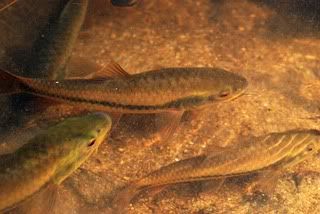
Myself and my collegue, Dr Mark Everard, are more interested in the smaller species of fish, hence looking at Neolissichilus. Although we were lead to these stocks by others who, mistakenly, believed they were Tor putitora from the Himalaya.
I use Dr Daniels' book as one guide to identification. Also, I have books by Jayaram and Jingran, including the Checklist of Freshwater Fish. I also have contact with Dr Basavaraja at Mangalore University, he is an expert on breeding of freshwater fish and a Dr Rao, who is a fellow Fishbase collaborator.
It seems to both myself and Dr Everard, that these fish are most certainly the species mentioned, which is declared critically endangered due to only surviving in a single habitat.
What I need to do is:
1. find that single habitat to compare the species
2. interest someone locally in the need to protect the 'new' populations
3. possibly downgrade the Red Book status
I will be in Karnataka next April and would love to be able to move some of these things forward. I know that Coorg Wildlife Society will assist with the protection of the fish, but this would be greatly enhanced if an expert were to take this on board.
I have a suspicion that some of these fish, or a very similar species exists in the main Kaveri river as well. This may be possible to determine on my next trip.
Giving the matter some considerable thought, I believe that the 'known' population as listed in the Red Book, must exist in a West-flowing river, while all the populations that I have found are in East-flowing catchment. While this raises the possibility of mis-identification, I am pretty sure that the species we have studied is Neolissichilus wynaadensis or a very close relative.


Reply With Quote
Bookmarks